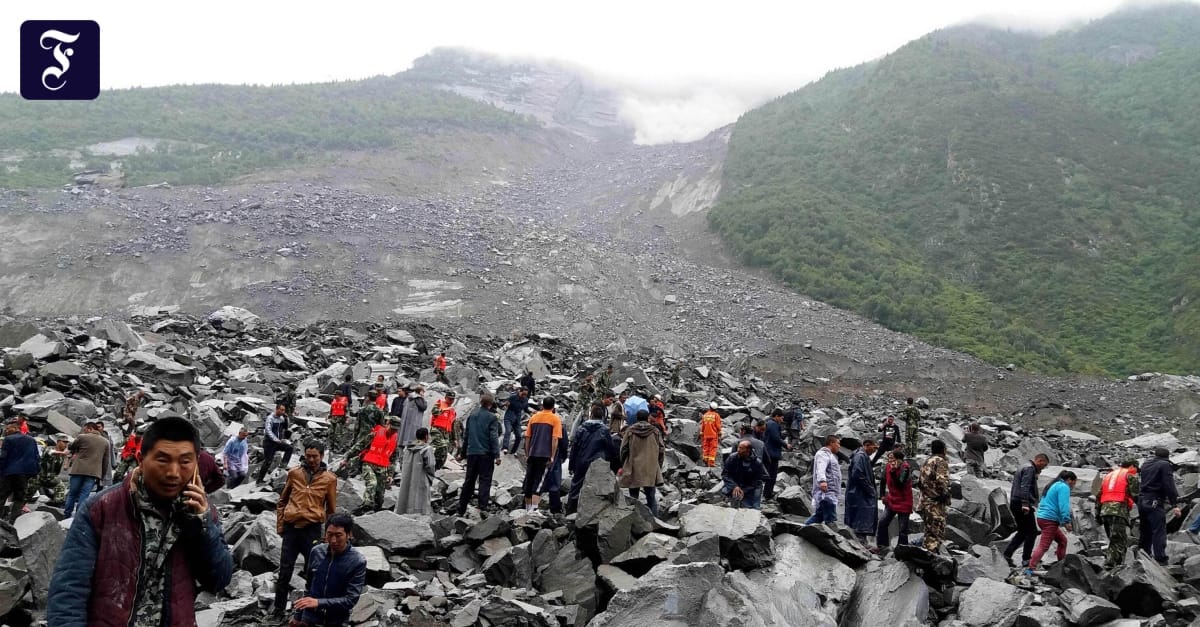
A catastrophic landslide in China’s southwest Sichuan province has caused widespread devastation, leaving over 30 individuals unaccounted for and claiming at least one life. Local authorities reported that the landslide occurred on Saturday in Jinping village under Junlian county near the city of Yibin. Torrential rains that had been lashing the region in recent days are being cited as one of the primary causes of the disaster.
The calamity struck at around 11:50 a.m. local time. Within moments, a large volume of earth and debris cascaded down mountainous terrain, obliterating everything in its path. Reports indicate that a total of 10 houses were buried under the deluge of mud and rocks, leaving dozens of residents trapped. Immediately, a Level 1 emergency response—the highest in China’s public safety protocols—was initiated by provincial authorities to mobilize resources and expertise to address the crisis.
Chinese state media and the Ministry of Emergency Management revealed that nearly 1,000 rescue workers, including firefighters, medical teams, and geologists, have been deployed to the disaster site. Rescue operations are being conducted under challenging circumstances, as heavy rainfall continues to impede efforts. The muddy terrain and risk of secondary landslides amplify the hazards for rescuers. Despite these challenges, two survivors have been rescued from the wreckage so far, offering a glimmer of hope amidst the tragic situation.
The Jinping landslide also enforced the evacuation of hundreds of other villagers from neighboring areas deemed to be at risk of similar incidents. Authorities have dispatched emergency supplies such as tents, food, and water for the displaced, while emergency shelters have been established to accommodate the displaced families.
Meteorologists and geological experts believe that the recent unseasonal rains were the main contributors to the landslip. The volume of precipitation heightened soil looseness in the mountainous topography of Sichuan, setting the stage for the catastrophe. According to official estimates, the debris flow from the landslide stretched over a length of 1.2 kilometers with a total volume exceeding 100,000 cubic meters—enough to bury a small town.
Across China, landslides are not uncommon, especially in regions prone to seismic activities and heavy rainfalls such as Sichuan. This province was also the epicenter of devastating earthquakes in the past, which have gradually eroded the geography and infrastructure of the area. This vulnerability to natural disasters has brought land-use policies and ecological planning under scrutiny, with experts advocating for more comprehensive risk assessments.
Chinese Premier Xi Jinping has reportedly ordered an “all-out effort” in the rescue operation, placing emphasis on minimizing casualties and ensuring the safety of rescue personnel. His directive also called for a post-disaster assessment of regional vulnerabilities to preempt similar occurrences in the future.
As night fell on Jinping village, rescue teams worked tirelessly under floodlights, prioritizing areas where survivors were more likely to be trapped. Advanced equipment such as ground-penetrating radar and drones equipped with thermal imaging capabilities have been deployed alongside traditional tools. Residents outside the immediate vicinity of the landslide have come forward with vital information, aiding rescuers in triangulating the search area.
The emotional toll on the affected families is enormous. For many, uncertainty about the fate of their loved ones looms heavily as hours turn into days—a window during which survival rates generally dwindle. Addressing the psychological impact of such disasters is another crucial aspect of recovery, one that relief workers are striving to account for.
This tragedy has also prompted discussions on broader climate policies and urban planning reforms necessary to mitigate and adapt to extreme weather events. With climate changes predicted to intensify, the ability to avert and respond to extreme weather-driven disasters is becoming a priority globally.
In the wake of the landslide, an outpouring of support, both domestic and international, has been observed. Social media platforms are flooded with expressions of solidarity and suggestions of potential aid. However, questions linger about whether lessons from similar previous events, such as the Sichuan quakes and other regional landslides, were effectively implemented to prevent such a disaster.
The landslide in Jinping is yet another reminder of the unpredictability and sheer force of nature. As feeding rains further complicate the rescue efforts, the resolve of the emergency response teams and the affected community resonates profoundly. For now, their efforts remain focused on finding survivors amidst the mud and rubble—a race against time under harrowing circumstances.
With rescue workers risking their lives in dangerous conditions, the tragedy also stands as a somber call for global resilience against climate hazards. Even as the world watches the unfolding-efforts in Sichuan on screens, the necessity of systemic changes to protect vulnerable populations becomes starkly apparent.