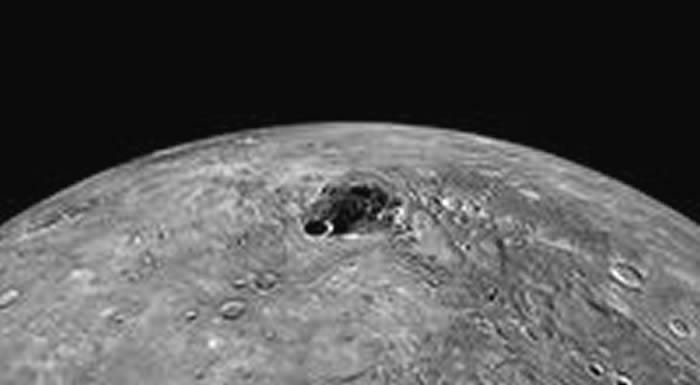
The BepiColombo mission, a joint endeavor between the European Space Agency (ESA) and the Japan Aerospace Exploration Agency (JAXA), has recently unveiled extraordinary images of Mercury’s north pole. This groundbreaking mission aims to deepen our understanding of the solar system’s innermost planet, which has long been shrouded in mystery due to its extreme conditions and proximity to the Sun.
Launched in October 2018, BepiColombo is designed to study Mercury’s surface, magnetic field, and exosphere. The spacecraft is equipped with a suite of scientific instruments that will allow researchers to gather data on the planet’s composition, geological activity, and thermal properties. As it makes its way to Mercury, BepiColombo has already begun to send back stunning images that reveal the planet’s unique characteristics.
The recent images of Mercury’s north pole are particularly significant. They showcase a region that is not only frigid but also features a variety of geological formations. The north pole is characterized by large, dark regions that are believed to be composed of carbon-rich materials. These areas are of great interest to scientists, as they may hold clues to the planet’s formation and evolution.
One of the most striking aspects of the images is the presence of large impact craters, which are a testament to Mercury’s violent history. The planet has been bombarded by asteroids and comets over billions of years, resulting in a surface that is heavily cratered. The images captured by BepiColombo provide a detailed view of these craters, allowing scientists to study their morphology and understand the processes that shaped them.
In addition to the craters, the images reveal the presence of polar ice deposits. These deposits are located in permanently shadowed regions of the north pole, where temperatures can plummet to extremely low levels. The discovery of ice on Mercury is particularly intriguing, as it suggests that the planet may have retained volatile compounds despite its harsh environment. This finding could have implications for our understanding of the distribution of water in the solar system.
The data collected by BepiColombo will also help scientists investigate Mercury’s magnetic field. The planet has a weak magnetic field, which is unusual for a body of its size. Understanding the dynamics of Mercury’s magnetic field is crucial for unraveling the planet’s internal structure and the processes that generate its magnetic field.
As BepiColombo continues its journey toward Mercury, it will conduct several flybys of Venus and Mercury itself. These flybys will allow the spacecraft to gather additional data and refine its instruments before entering orbit around Mercury. Once in orbit, BepiColombo will spend several years studying the planet in detail, providing a wealth of information that will enhance our understanding of Mercury and its place in the solar system.
The images from BepiColombo’s initial observations are a testament to the capabilities of modern space exploration technology. They not only provide a glimpse into the harsh and enigmatic world of Mercury but also highlight the importance of international collaboration in advancing our knowledge of the universe. The mission represents a significant step forward in planetary science, and the data collected will likely influence research for years to come.
In conclusion, the extraordinary images of Mercury’s frigid north pole captured by the BepiColombo spacecraft mark a significant milestone in our exploration of the solar system. As scientists analyze these images and the data collected during the mission, they will gain valuable insights into the geological history, surface composition, and environmental conditions of Mercury. The findings from BepiColombo will undoubtedly contribute to a deeper understanding of not only Mercury but also the broader processes that govern planetary formation and evolution throughout the solar system.