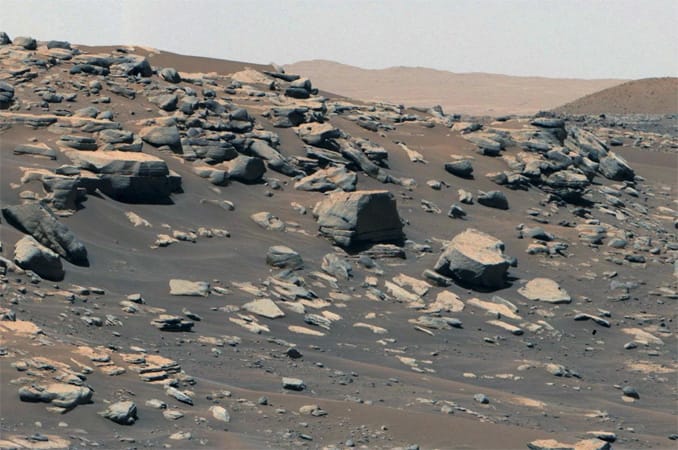
NASA’s Perseverance Mars rover has achieved another remarkable milestone in its ongoing mission to unravel the mysteries of the Red Planet. During its exploration of Mars’ Jezero Crater, the rover retrieved a unique rock sample from a region scientists have nicknamed “Silver Mountain.” This discovery has been described by the mission team as one of the most significant to date, offering a tantalizing glimpse into Mars’ ancient geological and possibly biological past.
Silver Mountain, a rocky outcrop within the Jezero Crater, is believed to date back to Mars’ Noachian era, approximately 4 billion years ago. This period in Martian history is of particular interest to scientists because it was marked by the presence of liquid water on the planet’s surface—a critical factor in the search for evidence of ancient microbial life. The area was chosen as a sample collection site after extensive remote analysis indicated that its unique geological features could provide valuable insights into Mars’ ancient environment.
The specific rock sample collected, known locally among the mission team as “Silver Mountain,” is the rover’s 26th sample retrieved since its landing on Mars in February 2021. Unlike previous rocks collected by the rover, this sample is characterized by textures and compositions that have not been observed before. Early analyses of images captured by Perseverance’s onboard cameras suggest the presence of microscopic structures that may help researchers understand the interactions between the planet’s water, minerals, and atmosphere billions of years ago.
The sample, which measures approximately 1.1 inches in diameter, has been carefully sealed in a precision-engineered titanium tube. This containment ensures that the sample remains uncontaminated, preserving its scientific value for detailed studies to be conducted back on Earth. NASA plans to return these samples to Earth as part of its Mars Sample Return (MSR) program, an ambitious initiative expected to launch retrieval missions in the 2030s.
Dr. Maya Chandra, a planetary geologist at NASA’s Jet Propulsion Laboratory, stated, “Silver Mountain gives us a new window into Mars’ past. The sample provides a puzzle piece that may help us understand how and when water existed on the planet and whether it sustained environments capable of supporting life.” Dr. Chandra also emphasized the importance of global collaboration in the Mars Sample Return effort, as scientists from around the world will analyze the sample to unlock its secrets.
The Jezero Crater itself has been a hotbed of scientific activity. Once thought to have been a massive lake teeming with flowing rivers, Jezero represents an ideal site for discovering biosignatures or chemical variations that suggest past life. The crater’s sedimentary layers preserve a rich history of environmental conditions, and Silver Mountain adds another dimension to the ongoing exploration.
This discovery aligns with one of Perseverance’s core objectives: to support the search for past microbiological life by investigating the Mineralogical, chemical, and isotopic composition of Martian rocks. The rover’s advanced suite of scientific tools, including SHERLOC (Scanning Habitable Environments with Raman & Luminescence for Organics and Chemicals) and PIXL (Planetary Instrument for X-ray Lithochemistry), has been instrumental in identifying and analyzing promising rocks such as Silver Mountain.
Beyond the excitement of the rare rock sample, Silver Mountain’s discovery highlights the broader goals of NASA’s Mars exploration initiatives. Understanding Mars’ geological history and habitability has implications not only for science but also for the future of human exploration. The Perseverance rover, launched in July 2020, is part of a long-term strategy known as the Moon to Mars program, which aims to prepare humanity for eventual human missions to Mars. Insights gleaned from missions like Perseverance pave the way for both scientific discovery and practical considerations for future explorers, such as in-situ resource utilization.
The scientific community eagerly anticipates the future analysis of Silver Mountain, which could take years. In the meantime, Perseverance continues its mission, exploring new terrains and collecting additional samples. Each new discovery adds a layer of complexity and understanding to humanity’s quest to comprehend the Red Planet’s past, one revealing rock sample at a time.