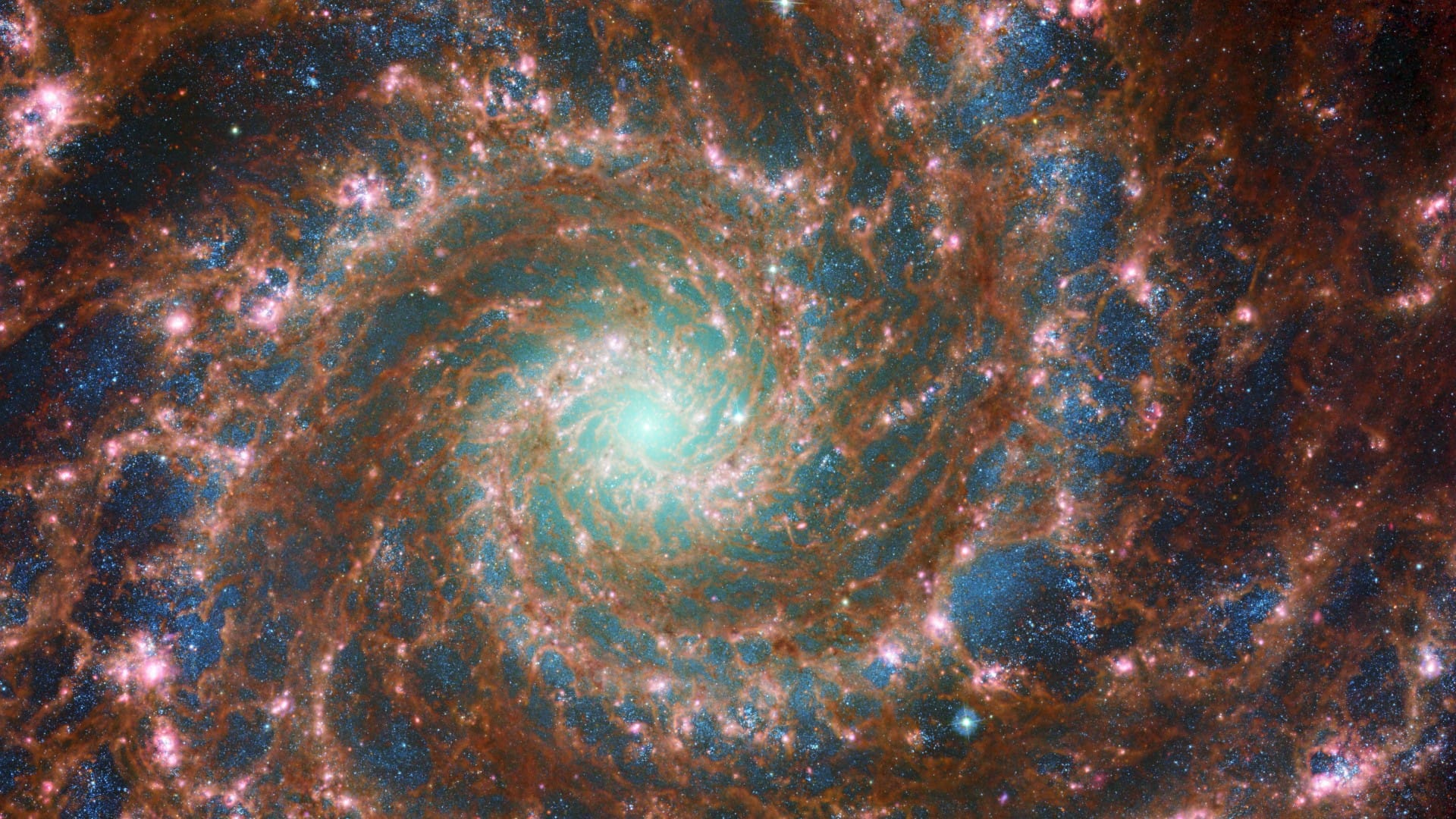
The James Webb Space Telescope (JWST), celebrated for its groundbreaking contributions to our understanding of the cosmos, has unearthed “impossible” black holes in the early universe. These celestial phenomena, described as being “monster” in size, defy traditional theories of cosmic evolution, raising fresh questions about how such objects could develop so rapidly following the Big Bang.
Traditionally, black holes emerge as remnants of massive stars that have ended their lifecycle in violent supernova explosions. These stellar remnants then slowly grow by accumulating matter over billions of years, either through mergers with other black holes or by pulling in surrounding gas and dust. However, the black holes detected by the JWST appear to defy these principles. Observations suggest that such vast structures existed just a few hundred million years after the universe’s formation—a timeline far too short for conventional black hole growth processes to apply.
The puzzle began with the JWST’s observations of ancient galaxies scattered across deep time. The telescope, operating in infrared wavelengths, was able to peer through the darkness of the early universe, revealing details of black holes embedded within these primordial galaxies. Many of these galaxies, far smaller than the Milky Way, inexplicably house black holes millions to billions of times the mass of our Sun.
Astrophysicists have struggled to reconcile these observations with prevailing cosmological models. The consensus explanation posits that such supermassive black holes could not have reached their observed sizes naturally in the available time frame. This gives rise to what astronomers have dubbed the “impossible black hole” conundrum.
Recent research exploring this enigma has centered on theoretical models involving exotic forms of matter. One leading hypothesis suggests that these black holes could be linked to the mysterious substance known as dark matter, which constitutes an estimated 85% of the universe’s matter but has never been directly observed. Dark matter does not interact with light and remains invisible, yet its gravitational effects are evident in the behavior of galaxies and larger cosmic structures.
The new theory proposes that these early black holes may have formed from an ultrarare variant of dark matter, potentially aiding their rapid growth. This exotic form of matter, if it exists, could condense and collapse faster than regular matter, seeding colossal black hole structures capable of explaining the JWST’s findings.
Dubbed “primordial black holes,” these entities might have emerged directly from quantum instabilities in the aftermath of the Big Bang. Unlike their traditionally formed counterparts, primordial black holes would not require preceding star formation for their existence. Instead, they may arise directly out of the soup of particles present in the newborn universe. If primordial black holes can grow by accreting surrounding matter, their sizes could theoretically swell to encompass the supermassive proportions seen in the JWST’s snapshots.
Some proponents of this theory suggest that such rare black holes could help explain larger mysteries in astrophysics, including the origin of galaxy formation. The gravitational pull of these hypermassive black holes would shepherd gaseous matter around them, jumpstarting early star and galaxy creation and providing the gravitational anchors necessary for these structures to expand.
Another intriguing possibility lies in the behavior of another leading candidate for dark matter: weakly interacting massive particles (WIMPs). These particles, should they exist, might decay or annihilate under the extreme conditions present in the early universe, releasing energy and generating the seeds of supermassive black holes. Observations of energy signatures corresponding with WIMP decay could theoretically strengthen this hypothesis, although no direct evidence has yet emerged.
While the hypothesis of primordial black holes is an enticing avenue of exploration, it is far from conclusive. Scientists require additional observations to establish a firm link between JWST’s findings and dark matter processes. The Extreme UltraViolet Explorer (EUVE) and other forthcoming observatories are expected to complement the JWST and help refine the picture of the early universe, possibly unveiling more about these perplexing features.
Another significant factor is that the JWST is uniquely suited for solving such mysteries due to its sensitivity to redshifted light from ancient epochs. Astronomers are already analyzing detailed spectroscopic data to determine the mass, energy output, and environment of the black holes detected thus far. These details could point to telltale markers of unconventional formation scenarios, such as primordial origins.
If confirmed, such findings would radically alter our understanding of cosmic history. Cosmologists would need to rewrite long-standing models detailing how matter and gravity interact, particularly during the universe’s infancy. Furthermore, the presence of supermassive black holes in the early universe might provide indirect evidence for the elusive dark matter particles, making the quest to identify their properties one of the highest priorities in modern physics.
In the meantime, the community remains enthused by the JWST’s ability to reveal previously unfathomable aspects of the cosmos. By peering deeper into time and space than ever possible before, the telescope underscores not only how far astronomical science has evolved but also how much more exists beyond the edge of human knowledge.
The discovery of these mysterious black holes may mark the start of a new era, one where our theoretical frameworks are put to the test against the observational goldmine generated by the JWST. As we await further evidence, the tantalizing concept of ultrarare matter continues to fuel scientific curiosity about the universe’s most profound secrets.