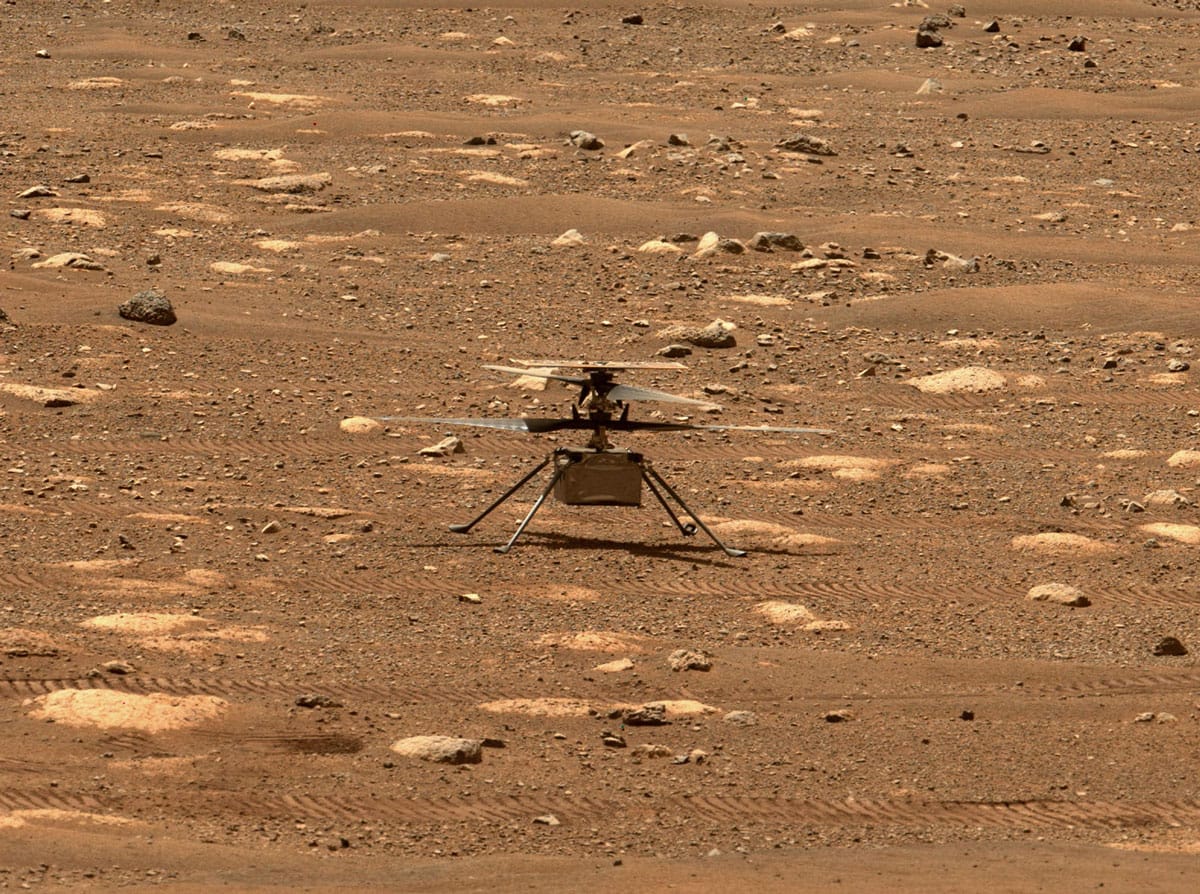
The Ingenuity Mars Helicopter, a technology demonstration project that significantly exceeded its original goals, experienced a critical incident during its 72nd flight on January 18, 2024, resulting in damage that rendered it inoperable. After a comprehensive investigation, NASA has released its findings, detailing the precise sequence of events that led to the helicopter’s hard landing. This event marks the end of Ingenuity’s groundbreaking mission but provides critical insights for future Martian aerial explorations.
The investigation focused primarily on the telemetry data collected by the helicopter and the Perseverance rover, which served as the communications relay. This data included imagery, inertial measurements, motor commands, and flight control parameters. The analysis revealed that the anomaly originated during Ingenuity’s descent phase, as it was approaching its designated landing site within the “Valinor Hills” region of Jezero Crater.
The helicopter, during normal flight operations, utilizes its onboard navigation system that combines inertial measurements with visual information obtained from its downward-facing camera. The system processes this information to maintain accurate position estimation and control. In the case of the final flight, the investigation concluded that the terrain’s characteristics played a significant role. The area consisted of a relatively flat, featureless surface with subtle undulations and small rocks. These features, while not problematic in themselves, proved difficult for the navigation algorithm to process effectively under the prevailing lighting and perspective conditions.
Specifically, the navigation software, which depends on recognizing and tracking distinct features in the visual input, experienced a critical error. Due to the lack of clearly defined and trackable visual landmarks in that area, the software inaccurately estimated the helicopter’s velocity and altitude during the descent. Instead of accurately determining the helicopter’s descent rate, the navigation algorithm mistakenly interpreted the visual information, leading to an underestimation of the rate of descent. This underestimation caused the helicopter to not slow its rotor speed at the correct time.
This erroneous calculation was compounded by the helicopter’s inherent design parameters and the Martian environment. Ingenuity is programmed to make minute and continuous adjustments to its rotor speed and orientation during flight. These adjustments are critical for maintaining stability and precise positioning. The software, responding to the erroneous position information, further adjusted its motor commands, leading to a mismatch between the commanded and actual rotor speeds. This mismatch ultimately resulted in a hard landing as the helicopter descended faster than intended.
The impact, although not cataclysmic, resulted in enough damage to the rotor blades to render the helicopter unfit for further flight operations. There was no indication of any motor malfunction or system failure besides this software calculation error. The onboard computers and other systems were also found to be fully functional after the landing.
The conclusion of the investigation underscores the inherent risks and challenges associated with operating sophisticated robotic vehicles in a foreign environment. NASA’s exploration of Mars is punctuated with challenges that go beyond terrestrial engineering standards. The data collected from the final flight and all of Ingenuity’s previous flights is invaluable for the continued research and development of advanced systems for space exploration and will serve as a crucial resource for future missions. These lessons are invaluable for the design and operation of future robotic aerial vehicles and their navigation systems, both on Mars and other celestial bodies.
Ingenuity’s mission is considered a phenomenal success. Originally designed as a technology demonstration, Ingenuity was tasked with completing only five test flights within a 30-day window. It exceeded all expectations, completing 72 flights across nearly three years, significantly contributing to the understanding of the practicalities of aerial exploration on Mars. These flights covered a wide range of terrains and distances, pushing the boundaries of what was previously considered achievable.
The mission’s longevity and success have provided a unique insight into Martian atmospheric dynamics and have validated key technologies crucial for future robotic missions. The mission also demonstrated the capability of a helicopter operating in the thin Martian atmosphere, which is approximately one-hundredth the density of Earth’s atmosphere. The mission proved that it’s viable to perform controlled flight in the Martian environment, paving the way for future aerial platforms as a viable mode of exploration.
During its extended operations, Ingenuity acted as a pathfinder, scouting routes for the Perseverance rover and identifying potential sites of scientific interest. This collaborative approach significantly enhanced the efficiency of the rover’s surface exploration and its scientific data collection capabilities. Furthermore, Ingenuity’s flights provided valuable visual and mapping information of the Martian landscape. This data is now being used by planetary scientists and engineers in preparation for future human missions to the planet.
Ingenuity’s mission also served as an important step for autonomous robotic control in the harsh environments of space. The helicopter’s ability to make its own flight decisions, without direct human intervention, demonstrated the potential of artificial intelligence in robotic exploration. The flight control algorithms employed by the mission are complex. These algorithms take into account factors like wind speed, atmospheric pressure, and the terrain’s texture. These technologies are being refined and improved using data collected from the flights. These advancements will have implications not only for future space missions but also for automated and autonomous vehicle technologies here on Earth.
Despite its abrupt end, the Ingenuity mission has contributed incalculably to the progress of space exploration. NASA and the engineers working on the project have gained insights into the complexities of operating autonomous vehicles in a foreign environment. The data collected from its flights will be invaluable in designing even more capable and robust robotic platforms. Future aerial vehicles may include improved navigation systems, advanced software, and even different rotor configurations. The team is now focused on applying lessons from the Ingenuity mission to future exploratory robotic platforms.
The success of the mission also demonstrates the importance of investing in technology demonstrations that push the boundaries of innovation. The project’s success has instilled confidence in the possibility of future aerial exploration on Mars and perhaps other celestial bodies, like Titan. The Ingenuity project is a testament to human ingenuity and the power of collaborative efforts in achieving unprecedented results. The final incident with Ingenuity provides vital information about the conditions on Mars and how the navigation system software was challenged by the terrain. This knowledge will make future missions more effective and safer. The lessons learned from this mission are not just academic they’re practical and will help shape future exploration efforts and expand our understanding of the Red Planet and the potential for future scientific research and discovery.
NASA and the team behind Ingenuity are now sharing the mission findings with other space agencies and research organizations, ensuring the broadest possible use of the information gathered during the mission. This collaboration will enable future exploration missions to be built on the extensive knowledge base generated by the Ingenuity helicopter project. This work continues to demonstrate the spirit of discovery and the dedication of scientists and engineers working to unlock the secrets of the universe.