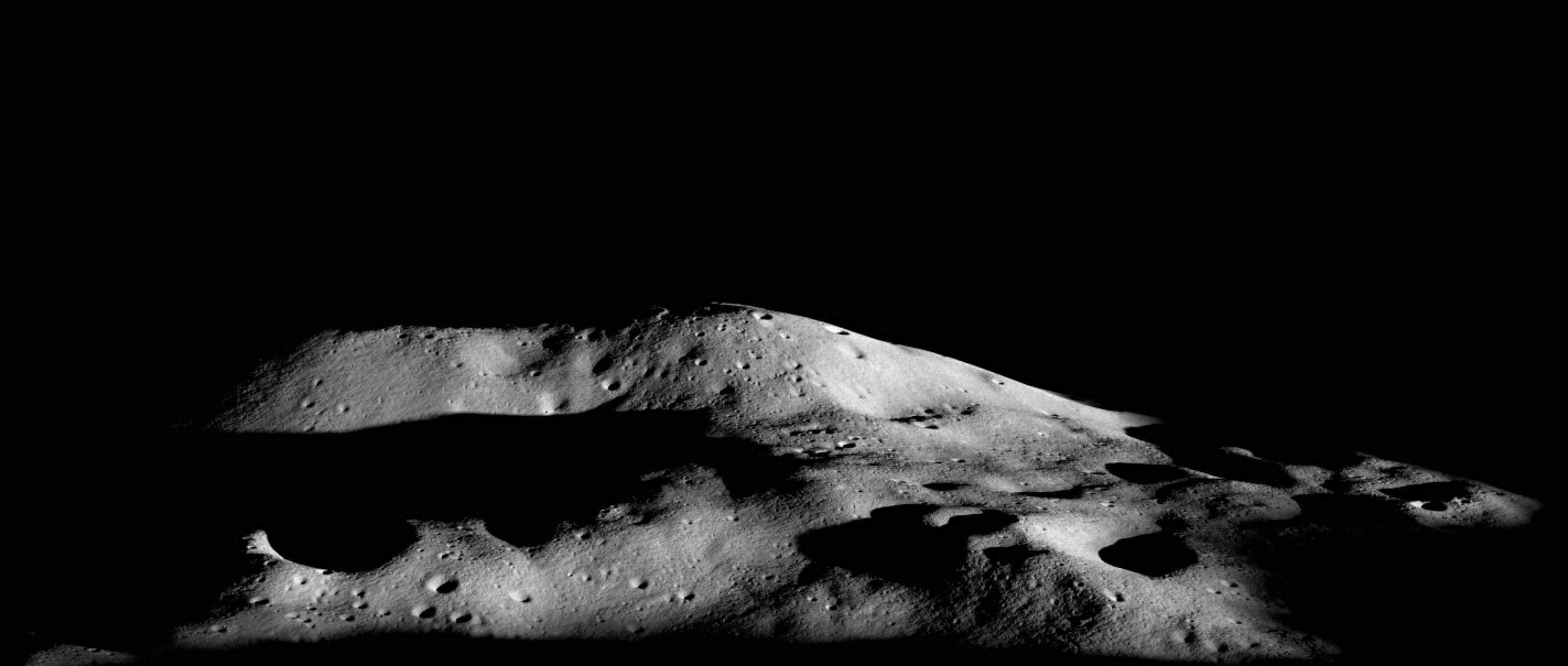
The Moon, Earth’s silent celestial companion, bears testament to a tumultuous early history. Among its most astonishing geological features are two colossal canyons on its far side, formed through an extraordinary and brief sequence of events 3.8 billion years ago. Recent research has shed light on how an asteroid’s colossal impact carved these immense valleys in just ten minutes, challenging our understanding of geological change in both pace and magnitude.
These features, named Vallis Schrödinger and Vallis Planck, are each as vast as the Grand Canyon in the United States. While the Grand Canyon took millions of years of wind and water erosion to achieve its iconic form, these lunar canyons materialized in a geological instant—not through gradual processes but rather through a cataclysm of immense energy.
The research, conducted by scientists from multiple international institutions, revealed that an asteroid or comet, approximately 25 kilometers wide, impacted the Moon near its south pole. Striking at a velocity of nearly 55,000 kilometers per hour, the object triggered an energy release far outstripping Earth’s entire nuclear arsenal. The resulting blast ejected high-speed streams of debris, carving the deep valleys that pierce the lunar surface to this day.
The Schrödinger impact event, as scientists have dubbed the collision, profoundly altered the Moon’s topography. Most notably, it created the Schrödinger Basin, a multi-ringed impact structure near the lunar south pole. From this basin, two geological scars radiate outward—evidence of the sheer dynamism of the asteroid impact. These scars are the canyons: Vallis Schrödinger and Vallis Planck.
What makes these valleys particularly fascinating is their formation mechanism. While Earth’s Grand Canyon was shaped predominantly by the Colorado River’s slow erosion and tectonic uplift, the lunar canyons were gouged out almost instantaneously. The rapid ejection of superheated rock and debris during the crash flowed across the Moon’s surface like rivers of fire, etching the landscapes that remain frozen in time.
This moment in the Moon’s life occurred during the Late Heavy Bombardment, a chaotic period when asteroids and comets frequently collided with planetary bodies in the inner solar system. Scientists posit that such events played a vital role in shaping planetary surfaces and even delivering water to Earth. In the case of the Moon, they left a quieter, enduring sign: its vast craters, basins, and canyons.
Advances in technology, including orbital imaging by lunar missions, provided the basis for this groundbreaking discovery. High-resolution images and topographical data allowed researchers to reconstruct the sequence of events following the impact. Models and simulations suggest that the debris surged outward from the central crater at speeds surpassing 4 kilometers per second, carving the two massive valleys almost instantly.
One of the study’s byproducts is its implications for NASA’s planned lunar exploration missions. The exploration of the Moon’s southern regions, including the Schrödinger Basin, may offer valuable knowledge about lunar history and geology. Importantly, the proximity of these impact features to the Moon’s south pole increases their scientific relevance. The pole region is home to permanently shadowed craters, which may harbor water ice—an essential resource for future human exploration.
Understanding the Moon’s tumultuous past also helps place these findings into a broader context of planetary science. Many bodies in our solar system, from Mars to the moons of outer planets, bear the scars of ancient impacts. By studying the dynamics and outcomes of such events on the Moon, researchers gain insights into planetary formation and the processes that shape celestial environments.
While the Moon lacks the weathering forces present on Earth, allowing these canyons to remain preserved, their existence reminds us of the violent forces that originally sculpted many seemingly serene celestial bodies. The Schrödinger impact not only redefined part of the Moon’s landscape but also marked a significant chapter in its geologic and scientific narratives.
In coming years, scientists hope to investigate these valleys further, both through remote sensing and potentially via lunar missions that might land within the Schrödinger Basin. These missions, potentially equipped with rovers and advanced sampling tools, could uncover new details about the Moon’s geology, shedding new light on this ancient cosmic event.


