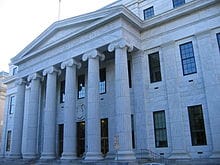
New York’s Court of Appeals, the state’s highest judicial body, is slated to hear arguments on Tuesday regarding a contentious law that would grant voting rights in local city elections to over 800,000 noncitizen residents. This marks a critical juncture in the ongoing legal battle over the New York City Noncitizen Voting Law, first passed in 2021 but subsequently invalidated by lower courts.
The law, aimed at enfranchising legal residents such as green card holders and immigrants under the Deferred Action for Childhood Arrivals (DACA) program, would permit noncitizens who have lived in the city for at least 30 consecutive days to participate in municipal elections. Advocates argue that the inclusion of this population reflects the city’s diverse demographics and gives immigrants a political voice in local governance. Opponents, however, claim that the measure contravenes the New York State Constitution and undermines the concept of citizenship-based voting rights.
Originally passed by the New York City Council in late 2021, the law went into effect on January 9, 2022, after Mayor Eric Adams opted not to veto the measure. Soon after, the legislation was challenged in court by the Republican National Committee, the New York Republican State Committee, along with various elected officials and private citizens. Critics of the law assert that it explicitly violates the New York State Constitution, which requires that voters must be U.S. citizens and suggests that altering voting eligibility requires a public referendum.
Proponents of the law counter that the state constitution’s provisions regarding voting only apply to statewide or federal elections, leaving municipalities the authority to set their own rules for local ballots. They further argue that the legislation’s aims are consistent with the broader principles of suffrage and democratic representation. According to the city’s legal representatives, the law does not require a referendum under the state’s Municipal Home Rule Law.
Lower court rulings have delivered setbacks to the legislation’s supporters. In June 2022, a trial court declared the law unconstitutional, citing the absence of explicit language in the state constitution to permit noncitizen voting. This decision was upheld by an appellate court in 2024 in a 3-1 ruling. The appellate court’s majority opinion agreed with the trial court that the law conflicted with constitutional provisions but stopped short of finding it in violation of state election laws.
Dissenting in both cases, certain judges have argued that municipal autonomy under Article IX of the state constitution provides for such legislative measures. Justice Lillian Wan, in her dissenting opinion, posited that the state constitution’s limitations on voting eligibility pertain only to statewide or federal elections, not municipal votes. As a result, local governments like New York City retain the right to expand voting eligibility without requiring a statewide public referendum.
The issue now rests in the hands of the seven judges on the Court of Appeals, who are charged with determining the law’s validity based on constitutional, statutory, and municipal principles. The decision they render will have far-reaching implications not only for the proposed legislation but also for the broader discourse on the rights of noncitizens in U.S. governance.
Opponents of the noncitizen voting measure argue that granting voting rights to over 800,000 noncitizens, roughly 15% of the city’s electorate, would dilute the voting power of U.S. citizens and shift the dynamics of local political campaigns. Proponents contend that the law addresses the democratic deficits faced by the city’s immigrant population, many of whom contribute to their communities but lack representation in local decision-making.
The oral arguments, scheduled for February 11, will be broadcast live, underscoring the public interest in this landmark case. Legal scholars and political analysts alike are closely watching the proceedings, as the outcome could set precedent for similar legislative efforts in other U.S. jurisdictions. While several U.S. cities, including San Francisco and those in Vermont, already allow noncitizen voting in certain contexts, New York City’s law would affect the largest population of noncitizen voters in the country.
The decision by the Court of Appeals is expected to be released in the coming months. Regardless of the outcome, the case underscores a growing debate over the role of noncitizens in shaping municipal governance and the extent to which localities can assert their legislative independence amid broader constitutional frameworks.
As the legal battle unfolds, the case captures the complex intersections of constitutional law, municipal autonomy, and immigrant enfranchisement, signaling its significance in the ongoing evolution of democratic governance in New York and beyond.


