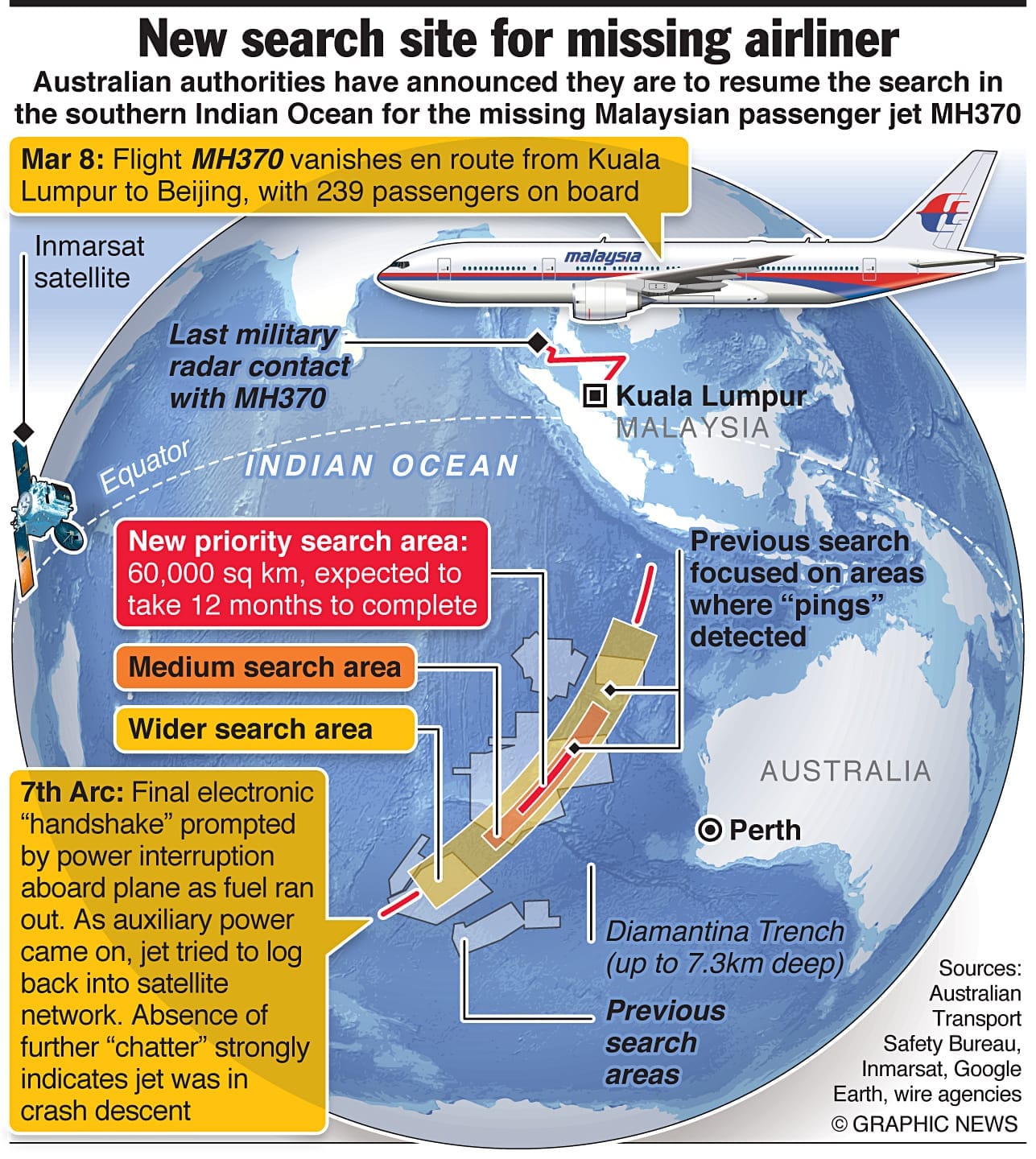
On March 8, 2014, Malaysia Airlines Flight MH370, a Boeing 777, disappeared from radar during a flight from Kuala Lumpur to Beijing, sparking one of the most extensive and perplexing searches in aviation history. The disappearance resulted in a multi-national search and rescue operation that spanned vast stretches of ocean, employing cutting-edge technology and deep-sea exploration methods. Despite the efforts, only a handful of debris pieces have been recovered, leaving families and investigators with more questions than answers.
In an update that might mark a significant development in this ongoing saga, Malaysia’s government has officially agreed to initiate a new search for the missing flight, ten years after it vanished without a trace. Prime Minister Anwar Ibrahim confirmed the government’s commitment to revisiting various theories and utilizing advances in technology that have emerged since the original search.
The decision to resume the search has been met with a mixture of hope and skepticism. There is widespread acknowledgment that previous efforts have not yielded substantial evidence pertaining to the location or fate of MH370. The initial search, which was coordinated by Australia, covered over 120,000 square kilometers of the southern Indian Ocean, but was suspended in 2017 with little significant progress. Following the initial search, smaller-scale efforts and private initiatives attempted to locate the aircraft, but none produced meaningful results.
This new search effort is expected to take advantage of technological advancements in satellite tracking, underwater drones, and oceanography. Experts in the field believe that innovative techniques may provide new insights into the trajectory of the aircraft and potential areas where debris could be located. However, a major challenge that remains is the vastness of the area being examined, combined with the inherent uncertainties regarding the possible flight path of MH370.
International interest in the MH370 mystery has remained strong, spurred in part by documentaries, books, and public fascination. The emotional toll on the families of the passengers has been significant, with many advocating for continued efforts to locate the aircraft. Some of these family members have established support networks to keep the conversation alive regarding the search for answers. Their campaigns have called on the Malaysian government and its partners to commit to new search ventures that explore unexamined territories of the vast ocean.
In the announcement of this renewed search, Prime Minister Anwar made it clear that the Malaysian government does not take this responsibility lightly. He emphasized the need to maintain transparency and collaboration with international partners to maximize the chances of success. In addition to Australia, which previously led the search, Malaysia aims to work with other countries and institutions that have shown interest in contributing to the investigation.
Experts in aviation and search operations have highlighted the importance of combining technological advancements with rigorous data analysis. New software algorithms capable of predictive modeling may help pinpoint areas of interest that were not previously considered. These models take into account numerous variables, including ocean currents, wind patterns, and the flight’s known behaviors. The hope is that a more refined search strategy will yield better results than its predecessors.
The new search initiative will not only focus on identifying the wreckage of the plane, but also aims to collect and analyze data that could shed light on the circumstances surrounding the flight’s disappearance. Understanding the sequence of events leading up to the aircraft’s final moments could provide critical insight that has thus far eluded investigators.
Moreover, the announcement comes at a time when advancements in deep-sea exploration have made it more feasible to conduct searches at extreme ocean depths. The development of specialized underwater drones has equipped researchers with tools to explore previously inaccessible areas of the ocean floor. These technologies may significantly enhance the search efforts and could uncover new leads in the MH370 investigation.
As Malaysia embarks on this renewed search, the international community will undoubtedly be watching closely. The fate of Flight MH370 remains an enigma, and the memory of the passengers and their families continues to be an enduring part of this narrative. While there are no guarantees that the new search will yield conclusive results, the resumption of efforts displays a commitment to unraveling the mystery and supporting those who are still left with unanswered questions about their loved ones.
With this announcement, Malaysia hopes to inspire renewed interest in the case and bring closure to a tragedy that has persisted for a decade. The government acknowledges the emotional and psychological toll this event has left, and the renewed search serves as a testament to the enduring spirit of inquiry and the promise of technological progress in the quest for resolution.