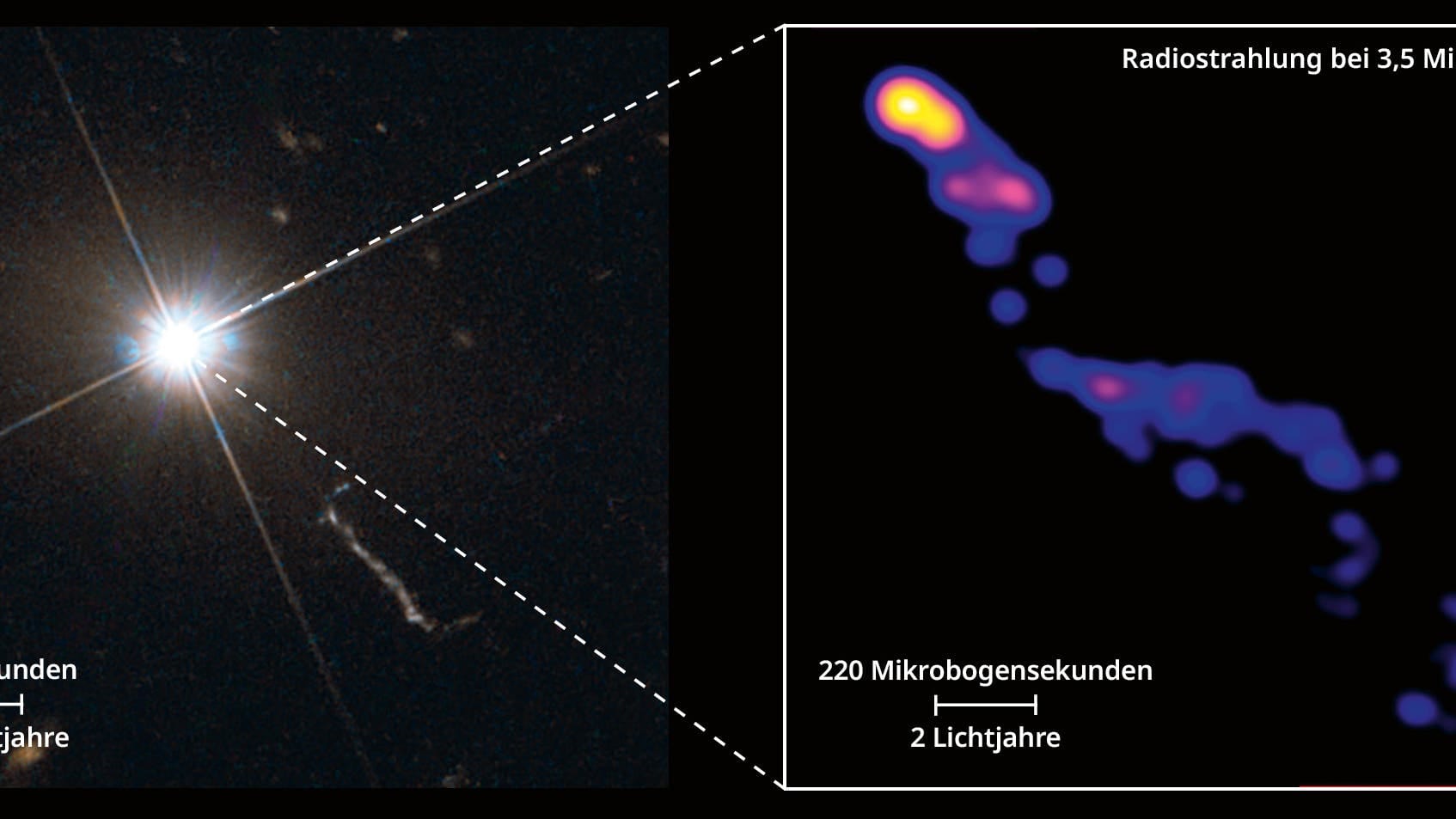
Astronomers have recently made a groundbreaking discovery, locating the largest radio jet ever observed in the young universe. Originating from a quasar positioned roughly 12 billion light-years from Earth, this colossal structure stretches across an extraordinary 200,000 light-years. The finding provides crucial insights into the early developmental stages of the universe and raises compelling questions about black hole dynamics during this period.
Quasars, often described as the “beacons” of the universe, are extremely luminous entities powered by supermassive black holes at the centers of distant galaxies. The quasar responsible for this discovery, identified as J1601+3102, lies in a time when the universe was merely 1.2 billion years old, a mere fraction of its current estimated age of 13.8 billion years. By capturing and studying the radio emissions from this jet, scientists are essentially looking back in time, revealing dramatic and powerful processes from the universe’s infancy.
The mammoth jet itself is generated as the quasar’s central black hole accretes massive amounts of matter. Not all the infalling material is consumed; some is accelerated outward at nearly the speed of light, forming twin jets of charged particles that emit potent radio waves. While radio jets of such magnitude are known to exist elsewhere in the universe, it is exceedingly rare to discover one of this scale in such an early cosmic epoch.
Scientists utilized several state-of-the-art instruments to study this remarkable phenomenon. Advanced telescopes, including LOFAR (Low-Frequency Array) and GNIRS (Gemini Near-Infrared Spectrograph), played pivotal roles in detecting and mapping the jet’s dimensions. The challenge of peering into such vast cosmic distances, where the light has taken billions of years to reach Earth, underscores the exceptional sensitivity and precision of modern observational technology.
The extraordinary size of this radio jet offers a wealth of scientific data. Its sheer scope—double the width of the Milky Way galaxy—suggests a highly efficient energy conversion mechanism operated by the quasar’s supermassive black hole. Additionally, the existence of such an extended jet challenges pre-existing models of galaxy evolution, as the quasar’s host galaxy likely provided an environment substantially enriched with gas and dust to sustain activity of this magnitude.
This discovery also sheds light on the underlying astrophysics governing the interactions between black holes and their surroundings. Radio jets like the one in J1601+3102 are known to play a key role in galaxy formation by dispersing gas clouds, triggering star formation, or, conversely, suppressing it. The energetic jets alter the cosmic environment, sculpting galaxies and influencing the emergence of structures that define the universe today.
The remote nature of this quasar and its jet underlines the importance of collaborative, multi-instrumental astronomy. Data from radio, infrared, and optical wavelengths collectively constructs a comprehensive narrative about the quasar’s properties. These methods reveal not only the scale of the jet but also hint at its origin, evolution, and potential lifespan.
One of the puzzling aspects of the discovery is the incredible luminosity of the quasar and its jet in such a distant and early period. Cosmologists speculate that the early universe might have had conditions conducive to the formation of supermassive black holes and their dramatic outflows. Unraveling these conditions will necessitate more sophisticated models and simulations to complement observational data.
Furthermore, the implications of this research extend beyond the study of black holes and jets. By analyzing such systems, astronomers gain a glimpse of the environment within galaxies several billion years ago. This information enriches our understanding of the universal frameworks that eventually produced the cosmic structures we observe today, including galaxy clusters and vast interstellar voids.
Although the quasar and its jet are monumental in scale and significance, this finding raises further questions: Why are such massive jets so rare in the early universe? How does their activity influence the eventual stability of their host galaxies? Answering these questions will likely shape the next decade of quasar and black hole research.
As the largest radio jet ever recorded from the early universe, J1601+3102 provides an extraordinary snapshot of a bygone cosmic era. It is both a marvel of the universe’s formative years and a gateway to understanding the mechanisms at play during one of the cosmos’s most dynamic phases. This discovery underscores the intricate blend of powerful forces and delicate balances that have sculpted the universe as we perceive it today.